homepage of Robbie Burgess
Research Interests
- self proclaimed pattern theorist
I talk about clouds, broken neon signs, plasma balls, prime numbers, glass, cement, grids of colors and numbers until whomever I'm talking to begins to cry.
ancient fortran programmer
("ancient" modifying "programmer")
Art
Generate random art with a hash function!
using the RFNG-2 hash function
(Robbie's Fragile Number Garden 2)
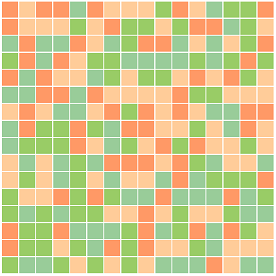
javascript code and haskell code for kubgen
(wrapped in html for web browser viewing)
haskell version for download
Physics
using the RFNG-2 hash function
(Robbie's Fragile Number Garden 2)
javascript code and haskell code for kubgen
(wrapped in html for web browser viewing)
haskell version for download
-
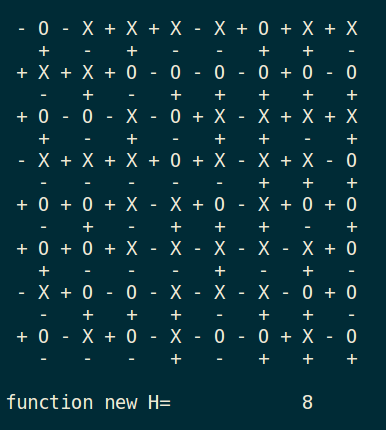
2D Ising model for a metallic spin glass
a very simple model of electrons in a mixed, sort of metal. The Xs and Os are electrons with spin up and spin down (the only two choices) and the +s and -s are the metal or insulators that mediate the interaction. Much like us, electrons want to be like their neighbors, but also don't want to change. It seems like it might have interesting behavior, but you'd be mistaken.
¯\_(ツ)_/¯
the fortran code on codeberg if you want to play around with it
-
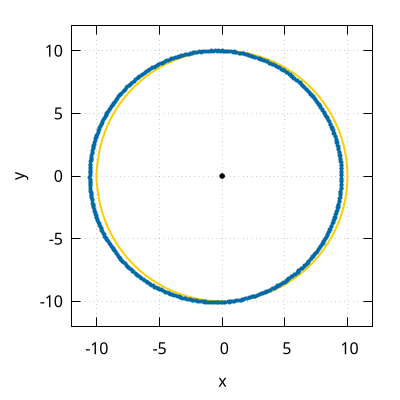
the above is the numerical solution in fortran of a body, say, a planet orbiting under a central gravitational force using the symplectic Eulerian method which is surprisingly good, although not Runge-Kutta good. The yellow is an actual circle. The blue is the numerical simulation. I know what you are thinking, someone spent hours making an almost circle. What can I say, I have a lot of free time. the fortran code
-
Mathematical Methods for Physics by James Nearing
(pdf ~3Mb download)My advisor, mentor and friend James Nearing wrote an excellent book of maths for physics students. He wanted it to always be available for free on the Internet, however the U Miami physics dept server is no more so here it is for you to enjoy. It is quite good. You can also buy a copy from Dover publishing from Amazon
- Online Student's t test I've had this on the web in some form since 1997! It started as a java applet, then when applets fell out of favor I had it as a perl program running from cgi-bin, now here it is as javascript. Enjoy!
- The beautiful student's t test probability algorithm initially I used a canned, closed source library to find the p value from the t statistic in the above student's t-test program, but it turns out there's a neat algorithm to find it.
- Of course, a fortran version of the student's t-test program with the above mentioned algorithm.
- funny R talk slideshow a funny-ish slideshow for a talk I gave on the stats language R for the biology department
Music: On soundcloud (doesn't work for some people) as mp3s if the above doesn't work Fun:
ekki
ancient zine uncovered and reproduced here!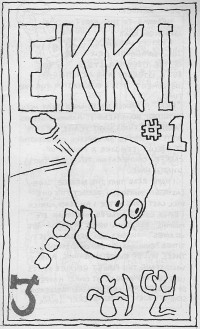
view as PDF
New stuffs!
- First track off of Lamprey Six's latest album "spidergoat" from Short Attention Span records!:

on soundcloud

mp3 - free to download and keep!
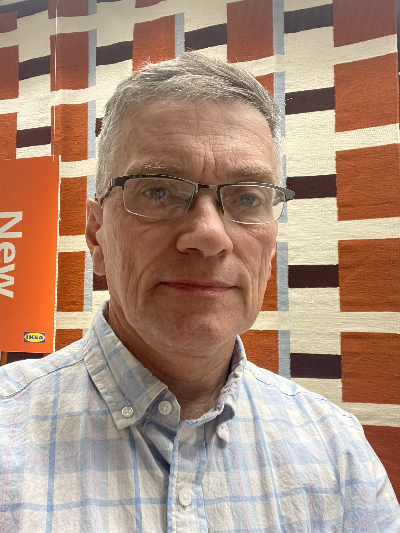
me
talk to me on Mastodon